Philippa Winterbourne-Cray
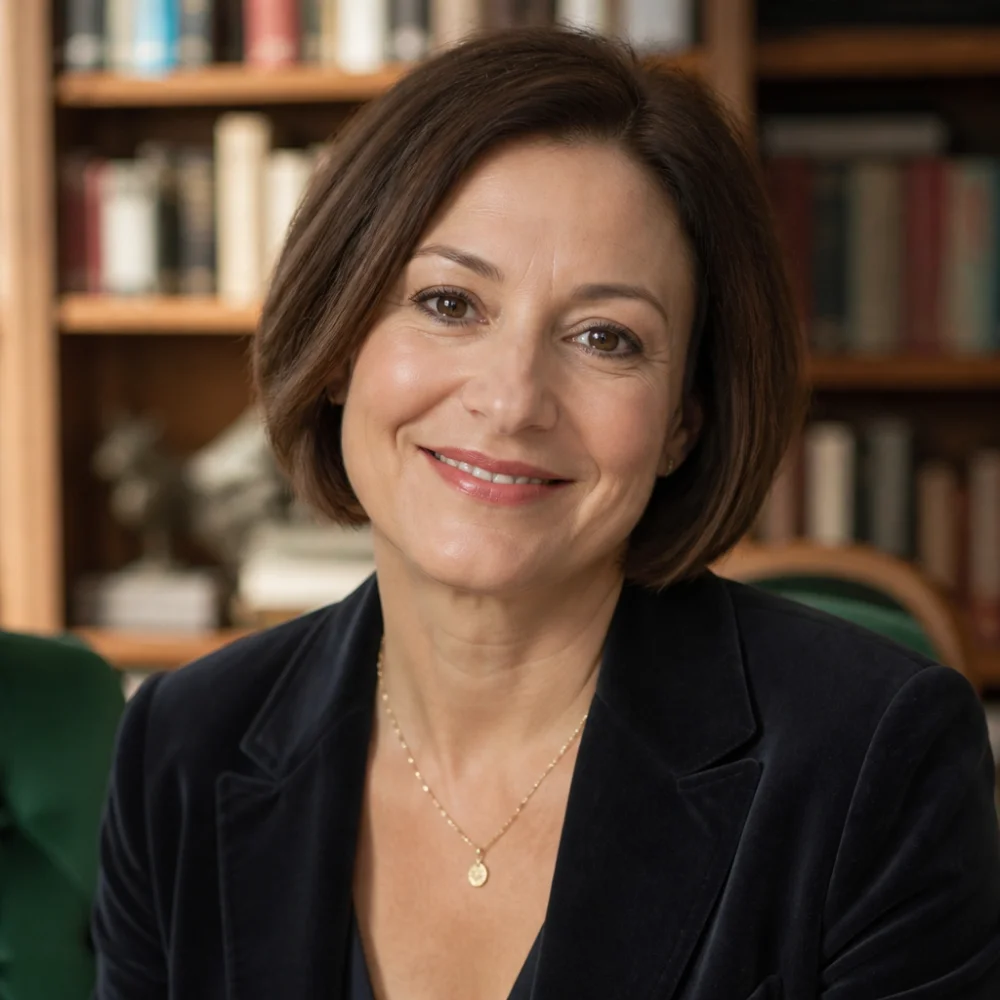
Philippa Winterbourne-Cray did not set out to become an editor. She arrived in Prague with a suitcase, a borrowed grammar book and the confident belief that a few months would be enough to get by in Czech. That belief lasted until her first visit to a corner bakery, where she asked for "dva rohlík" and was politely corrected by a woman who, she says, had clearly corrected hundreds of foreigners before her. It was a small moment, but it shaped everything that followed. Philippa realized that the difficulty of Czech was not the real problem. The problem was that nobody explained it in a way that made sense to a newcomer standing in a queue with a hungry stomach and a dry mouth.
Born and raised in England, Philippa trained as a linguist and spent her early career writing and editing educational materials. She worked on course books, study guides and online lessons, always with an eye for what makes a learner stumble. Czech, with its seven cases, its three genders and its famously stubborn consonant clusters, seemed to her both daunting and fascinating. She stayed in Prague longer than planned, enrolled in evening classes, filled notebooks with declension tables and gradually built a daily life in the language. Along the way she noticed a gap. Textbooks were thorough but often dry. Online forums were lively but unreliable. What was missing was a calm, practical, independent voice that would take the learner by the hand and say: here is what matters, here is how it works, and here is how to use it tomorrow morning.
That voice became "Czech in Prague." Philippa founded the magazine as an independent publication for foreigners learning Czech, and she remains its guiding editor. Her approach is built on a few simple principles. Grammar should be explained simply, without watering it down. Vocabulary should come with context, so that a word is never just a word but a tool for ordering coffee, renting a flat or talking to a neighbor. Advice should reflect real life in the city, from navigating the tram system to dealing with offices and enrolling in courses. And above all, the learner should feel capable, not overwhelmed.
As editor, Philippa is known for her insistence on clarity. She reads every article with the question of whether a tired beginner could follow it on a Tuesday evening after work. If the answer is no, the text goes back for revision. She favors short sentences, clear examples and honest admissions that some parts of Czech are simply difficult and need patience. She is equally firm that mistakes are not failures but the natural material of learning, and she often reminds contributors that the best lesson is one that leaves the reader curious rather than discouraged.
Her editorial interests range widely. She enjoys the small puzzles of Czech, such as why the language has so many ways to say "you" or how a single vowel can change a meaning. She is drawn to everyday phrases that unlock real conversation, and she has a particular fondness for the humor hidden in Czech idioms. At the same time, she takes the practical side of expat life seriously, believing that language learning cannot be separated from the experience of actually living in a place.
Under her direction, the magazine has grown into a resource for students, professionals and long-term residents alike, united by the wish to speak Czech with more confidence. Philippa still keeps a notebook of new words, still makes occasional mistakes in the bakery and still insists that this is exactly how it should be.