Tamsin Verity Hollowell
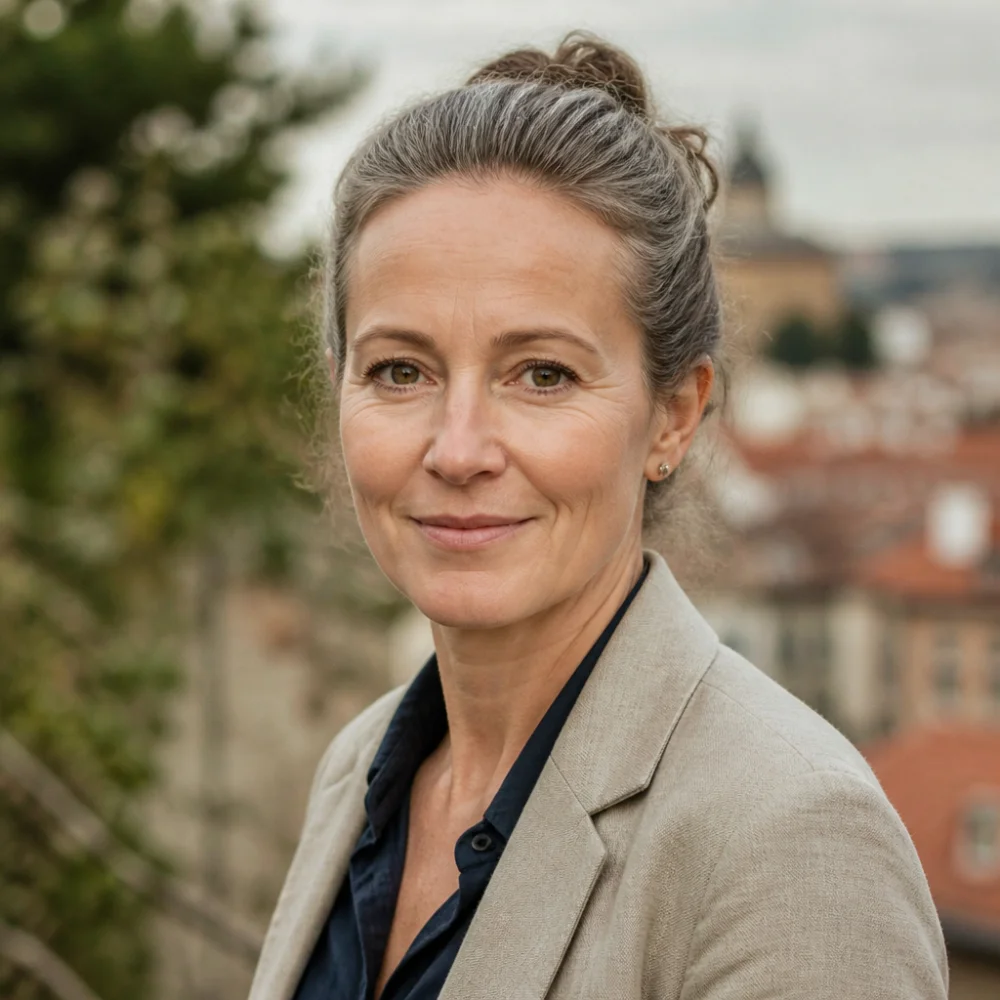
Tamsin Verity Hollowell is the editor of "Czech in Prague", and her relationship with the Czech language began, as it does for many of our readers, with confusion. She arrived in Prague with a rucksack, a phrasebook and a stubborn belief that a few weeks would be enough to order lunch and find the right tram. What she found instead was a language of seven cases, three genders, soft and hard consonants, and a sentence structure that seemed to rearrange itself every time she thought she understood it. That early frustration became the starting point for everything this magazine now stands for.
Tamsin did not set out to become an editor or a language teacher. Her first months in the city were spent doing what most newcomers do: pointing at pastries in bakeries, mispronouncing the dreaded letter ř, and discovering that the grammar rules in textbooks rarely matched the speed of real conversation at a market stall or a doctor's reception desk. She enrolled in evening courses, filled notebooks with declension tables, and gradually noticed a pattern. The explanations that helped her most were never the longest or the most technical. They were the ones that were short, honest and practical, and that told her what she actually needed to say in order to get on with her day.
That observation shaped her editorial philosophy. Tamsin believes that learning Czech should not feel like climbing a wall of rules. She prefers to explain grammar simply, starting from situations learners genuinely face: renting a flat, registering at the foreign police, chatting with a neighbour, ordering at a pub, or understanding a message from a landlord. Cases are introduced through useful phrases rather than abstract charts, and vocabulary is grouped around real life rather than arbitrary lists. She is also firm that mistakes are not a sign of failure. In her view, a learner who speaks imperfect Czech to a shopkeeper is making far more progress than one who waits silently until everything is perfect.
As editor, Tamsin sets the tone and standards for the whole publication. She is known for being concise and clear, and she edits ruthlessly for both. Every article is expected to answer a concrete question, give an example that can be used the same day, and avoid jargon unless the term is explained. She is particularly careful about accuracy, whether the topic is a verb conjugation, a pronunciation rule or a practical tip about studying and living in Prague. When something changes, such as a procedure, a course format or a common usage, she insists that the magazine describe the current situation rather than repeat what was true years ago.
Independence is another principle she holds dear. "Czech in Prague" is not tied to any single school, textbook or method, which allows Tamsin to recommend what genuinely works and to be candid about what does not. She encourages readers to combine approaches: formal lessons, language exchanges, podcasts, reading short texts, listening to the city around them, and, above all, speaking whenever the opportunity arises. She often reminds learners that Prague itself is the best classroom, from the announcements on the metro to the menus in neighbourhood restaurants.
Outside the office, Tamsin can usually be found at a café with a notebook, collecting new phrases overheard in conversation, or walking through different districts to see how the language changes from one corner of the city to the next. She has a particular fondness for Czech idioms and the humour hidden in everyday expressions, and she believes that a learner who understands a joke in Czech has crossed an important threshold.
Her goal for the magazine is simple: to make learners feel less alone, better equipped and more confident. Whether you are a complete beginner memorising your first greetings or an advanced student wrestling with aspect and word order, Tamsin wants you to find something in these pages that makes tomorrow's conversation a little easier.